

The Downlow with DITA
A Q&A with the Jakarta-Bali DJ who’s been spinning her own story since day one.
You’ve reached Ghetto Gastro. Jon, Les, and P can’t come to the phone right now but subscribe and they’ll get back to you as soon as possible.
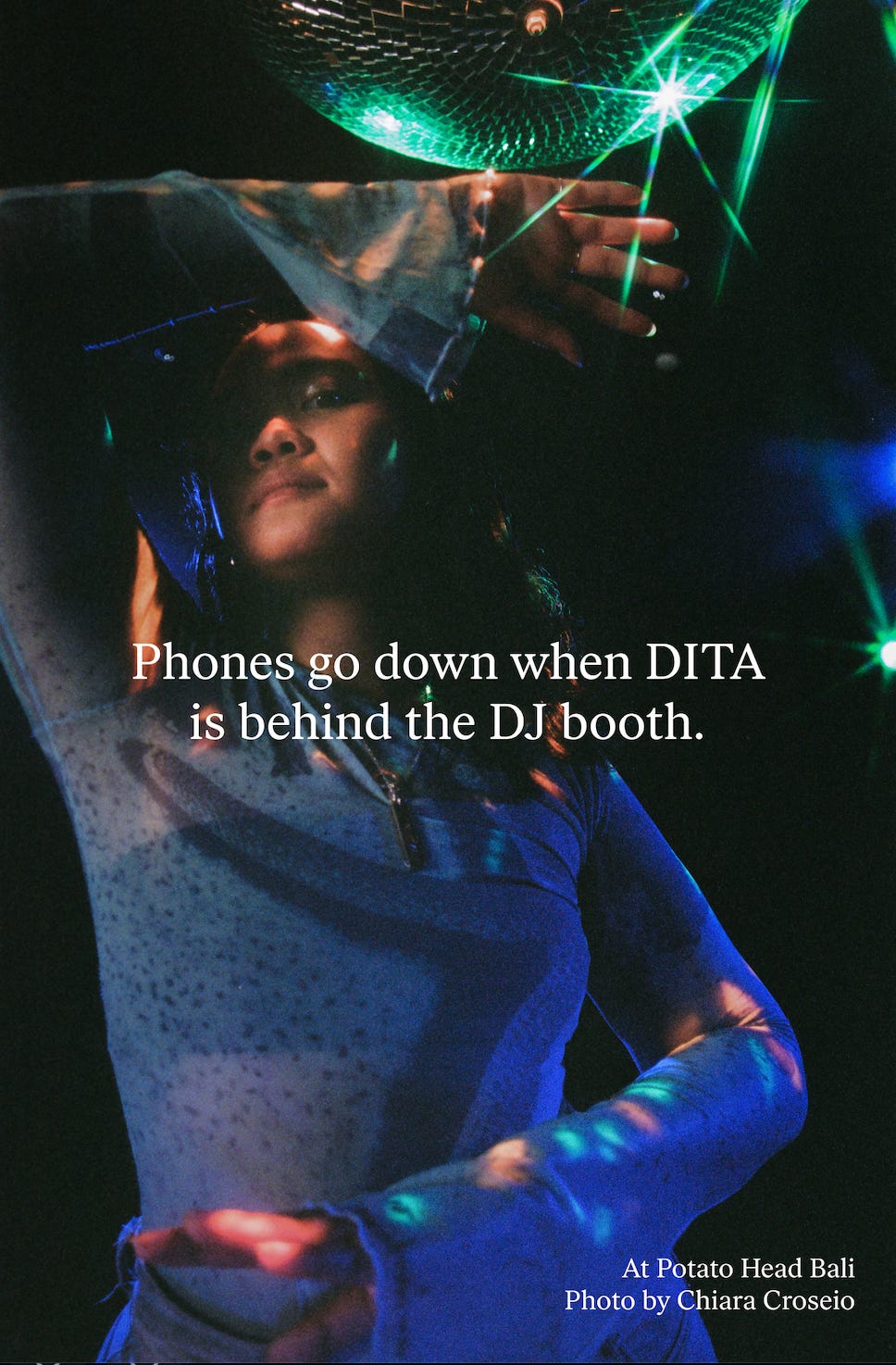
DITA has been cooking her own flavor since day one, developing a sound that pulls from proto-house, ’90s breaks, and disco. What began with her Perky Club collective in Jakarta and Bali quickly turned into a movement, with crowds tapping into her straightforward, no-rules approach behind the decks. From Potato Head (where she has a residency) to Panorama Bar, from Rainbow Disco Club to Wonderfruit, she’s carrying her people’s stories across continents, stitching her multicultural roots into a global sound system. We got to catch up with her, from the Bronx to Bali. This is DITA: clear point of view and talent. No one’s using their phones during her sets.
How did you get into music?
Music’s always been a part of my life. I grew up around parents who loved rock and were always playing music at home. I first got into it more seriously when I started managing a psychedelic rock band in Bandung. That experience really shaped my ears, it taught me to appreciate texture, mood, and energy in sound. Eventually I found myself falling deeper into electronic music, especially the stuff that still carried that trippy, emotional edge. DJing became a way to share those feelings with others.
How would you describe the current state of club culture in Indonesia? There’s a lot of talk that clubbing is a dying art. Do you feel that’s the case in Bali?
I don’t think clubbing is dying at all, if anything, it’s evolving. The pandemic definitely shifted things, especially for artists trying to tour in Asia, but it also brought people closer together. In Bali, there’s a stronger sense of community now. People aren’t just coming for the party, they’re coming for the music, the atmosphere, the connection. We’re seeing less emphasis on big headliners and more on the energy of the room. Clubs like Klymax really focus on the sound and the space, and that feels refreshing. It’s not dying, it’s just growing into something more intentional.
Tell me about Potato Head’s Klymax. World-renowned.
Klymax is a space that really honours music. Everything from the sound system to the layout of the room is designed with intention. People naturally don’t have their phones up in their hands, which means they are really present, they’re dancing, listening, connecting. It’s less about hype and more about feeling. Playing there as a resident has been one of the most rewarding experiences. You get to build a journey from start to finish and see the dance floor respond in real time. It’s a club for the heads, and I love that.
What elements of Indonesian culture are you thinking about when building a set or sharing your work with international audiences?
I think there’s a real emotional depth in Indonesian music, whether it’s traditional or contemporary. The rhythms, the scales, even the silence in between, there’s something hypnotic and grounding in it. I don’t always sample directly, but the spirit of it definitely influences the way I build my sets. I try to share a sense of time and place, but in a way that still feels universal. It’s not about saying “this is Indonesian music,” but more like, “this is where I’m from, and this is how I feel.”
Are the energies between Jakarta and Bali different? How has moving between the two shaped your evolution as a performer and a listener?
Definitely different. Jakarta is fast-paced, intense, full of contrast, it sharpened my ears, taught me how to cut through noise and find my own sound. It’s also where I met some of my closest collaborators and discovered how powerful community can be.


Bali, on the other hand, gave me space to breathe. It’s more open, a little more fluid. The crowd is mixed, the venues are diverse, and the energy feels softer but deeper. Playing here helped me trust my instincts more. I stopped thinking so much about genre and started focusing on feeling. Both places shaped me in different but equally important ways.
There’s so much talent in Southeast Asia, and we deserve to be seen and heard on our own terms. I’m excited to keep building spaces that let us do that, whether it’s through Klymax and Potato Head, or whatever comes next. And I’m always down to connect with others who feel the same way.
Best Bali eats?
Warung Nasi Liku. Best ayam betutu!
Nasgero. Fav nasi goreng here in Bali
Fu Shou Noodle Club. My go-to late night noodles!
Best places to enjoy music?
Klymax of course!
Karat, Bali
FED
LISEN TO DITA SPIN —>
More mixes for inquiring minds:
SOUND METAPHORS : MIX SERIES
NTS with MOXIE
NTS with SHANTI CELESTE
NTS with YU SU
KIOSK RADIO | PESONA with DITA
KEEP DIGGING
LES LASAGNA

For us, lasagna can sometimes lean too heavy on the meat flavor profile. You’ll build this one in the traditional way but it’s the finishing touches that set it apart. So instead of stopping at melted cheese, this lasagna gets plated over a roasted pepper cream sauce, finished with basil oil and a hint of chili. It brightens up the whole dish. The plating looks elevated too.
Paris dining guide

Paris food scene is painted as heavy on classic French fare, and we’re fans, but what makes Paris exciting is the global influence running through its kitchens. Udon noodles, Senegalese stews, and more vegan options than you’d expect. There are microcultures upon microcultures here. The biggest mistake you can make is ordering steak frites at every dinner.